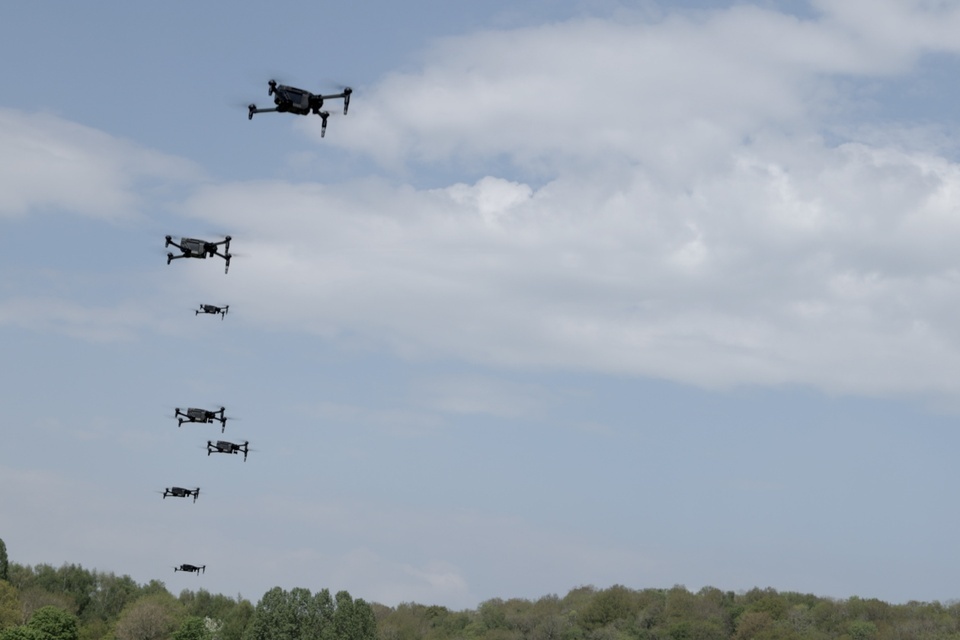
The UK’s September 25, 2026 competition for access to Ukrainian battlefield data explicitly sought ideas for drone systems that can keep working with degraded communications or unavailable satellite navigation. It also said appropriate human involvement must remain. The two ambitions belong together: losing a radio link may increase the need for onboard autonomy, but it does not answer who remains responsible for the mission. UK September 2026 Ukraine AI-data competition
Independence has several meanings
Our analysis distinguishes technical independence from institutional authority. A machine may continue an assigned task without continuous messages, but an organization still decides the task, approved conditions and stopping rules. Treating communications resilience as permission for unconstrained behavior confuses an engineering capability with a policy choice.
The right questions concern what the system does when information becomes uncertain. Does it continue within a narrow approved scope, seek help or cease the activity? Those choices should be part of design and evaluation. They should not be discovered only after the operating environment differs from the demonstration.
Evaluate the boundaries
Public reporting rarely exposes every operational constraint, and missing information should remain missing. A claim about coordinated autonomy does not independently reveal the extent of human supervision, deployment permissions or reliability under disruption. Analysts can explain why those factors matter without inventing details about a particular system.
The strategic value of resilience depends on trusted behavior. A system that continues operating but becomes impossible to predict or review may create new costs for its users and partners. Responsible autonomy policy therefore links continuity with bounded authority, meaningful testing and institutional responsibility. The goal is to preserve useful capability while keeping decisions connected to people who remain answerable for their consequences.
The competition is a development step
The government said up to twelve UK companies would initially gain access to Ukraine’s Avengers AI Labs database, containing daylight and thermal imagery gathered by uncrewed systems. It described more than six million object detections and sought proposals applicable to both British and Ukrainian requirements. Selection and exploitation of the data were still forthcoming in the announcement. UK September 2026 Ukraine AI-data competition
That makes this an opportunity to develop and evaluate models, not proof that a finished swarm has been fielded. Data access can be strategically valuable because it exposes developers to real operating conditions. But a large dataset does not automatically provide representative coverage, reliable labels or safe behavior outside the situations it contains.
Resilience changes where decisions happen
The competition categories include distributed decision-making, adaptive mission execution and collaborative sensing. Their common feature is reduced dependence on one central controller. That can help a team continue a bounded task when communications are disrupted. It also means the system’s internal rules become more important, because a remote person may not be available to correct every action. UK September 2026 Ukraine AI-data competition
Our analysis is that resilience should be judged against a clearly specified mission boundary. Continuing to navigate, maintaining separation and choosing whether to act on uncertain information are different behaviors. A system can be robust in the first two and still require a conservative limit on the third. Reporting that distinction avoids turning resilience into an unqualified claim of independent judgment.
The policy framework predates this competition
The UK’s 2022 AI policy addresses responsibility, understanding, reliability and the risks of unexpected behavior in new environments. It places obligations across the system lifecycle, including development and redeployment. That context matters because a model trained on one battlefield does not become automatically suitable for every geography, sensor or mission. UK defence approach to AI-enabled capability
The operational implication is that transfer itself needs evidence. A model may encounter different weather, terrain, civilian activity or equipment. Testing must show where the original assumptions still hold and where they do not. These are limits on a specific capability, not an argument that learning from Ukrainian experience is without value.
Humanitarian concerns remain after a link is lost
The ICRC–SIPRI study of human control identifies constraints on the system, its operating environment and supervision as complementary measures. The UN–ICRC August 2026 appeal seeks binding prohibitions and restrictions on autonomous weapons. These sources do not prescribe the exact behavior of the UK competition’s future products; they explain why technical resilience cannot resolve the broader accountability question by itself. ICRC–SIPRI practical human-control study UN–ICRC August 2026 autonomous-weapons appeal
A communications failure is an engineering event. Authorization to use force is a human and institutional responsibility. Conflating them risks treating the absence of contact as permission for broader action. A credible design should make its behavior under uncertainty part of the original mission definition and evaluation, rather than leave it to improvisation after deployment.
The evidence should follow the whole chain
The next public milestones are selection, model development, testing and any subsequent procurement. Each will support a different claim. A competition announcement identifies intent and resources; a trial can show bounded performance; deployment requires a further account of reliability, training and authority.
The UK–Ukraine initiative is significant because it links operational data to industrial development. Its strategic value will be stronger if improved resilience arrives with clearer evidence about limits and responsibility. The task is not merely to keep machines moving when communications fail, but to ensure they continue only in ways that the responsible human organization can understand and justify.
Sources & evidence
This archive preserves its original editorial date. Sources describe the events and announcements discussed; they do not establish today’s status.